Sunday, July 23, 2006

Anti-Inflammatory Cooking


Cold and flu in the summer are always a strange surprise, though not entirely unexplainable. If you live in a hot area, you'll notice that offices and homes tend to crank up the air conditioner in the summertime, making our daily journeys in and out of buildings a real challenge for our immune system.

Chinese medicine does not recognize illnesses as "flu", but categorizes the entire situation of the person by his or her warmth/coldness, dampness/dryness, etc. What Western medicine would call a cold, or a flu, usually falls into one of two categories: wind-cold and wind-heat. Wind cold is a cold which leads one to be sluggish, cold, and inactive; wind heat tends to be accompanied by fever and redness. Both, but particularly the former, are associated with dampness, which manifests itself as phlegm.

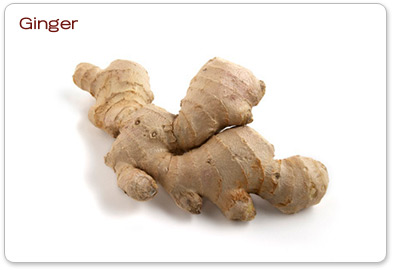
Milk and dairy products are generally considered to increase phlegm in the body, and are therefore not recommended at times when one has a cold. Whether one eats cold or hot foods (which would depend on the type of cold one has), drying, anti-inflammatory foods are of essence. When in doubt, the three winning ingredients are garlic, ginger, and lemon.

Here are some things you might want to try next time you have a cold:

* Ginger-lemon tea (affectionately referred to here as "lemon-ginj")
* Thai curries, preferrably soy-based (coconut milk is a bit rich for ill, sluggish systems, though also good)
* Spicy stir-frys with garlic and ginger
* Tchina with lots of lemon and garlic
* vegetable stock with a bit of grated ginger on top

Be well!

Wednesday, July 19, 2006

Those Big Purple Things

Our two most recent deliveries from Chubeza contained a beautiful surprise: the season's first nice, fresh, purple eggplants. What a thrill! Being a Middle Easterner means that I love eggplants a great deal, and have cooked them in many different ways. There aren't many things that are as local as eggplants; Israelis love them almost as much as they love their tomatoes and eat them in every possible form, from baba ganoush to mousakka to quiches to simply roasted slices with goat cheese and olive oil.

Some people have a hesitant relationship with eggplants. This stems from two main reasons. First, eggplants belong to the nightshade family of vegetables, which has been much maligned in relation to diseases like fibromayalgia. Some nutritionsts recommend avoiding nightshade vegetables altogether, a penalty inconceivable from the perspective of a Mediterranean person: that would mean giving up tomatoes, sweet peppers and potatoes. Ah, the horror! Indeed, nightshades contain a certain amount of poisonous components, but these are, according to most nutritionists, ruined in cooking, and they have several nutritional benefits to offer. Eggplants, for example, contain several vitamins from the B family, as well as manganese, copper, potassium, and folic acid. Not in great amounts, but still, they are all there.

The second reason people fear eggplants is their capacity to absorb unbelievable amounts of oil. Many eggplant dishes are extremely greasy and, while eggplant itself is quite lean, with the oil it can become a bit of a fat trap, albeit a delicious one.

Here's one pretty basic thing you can do with your eggplants. Eggplant salad is magnificent in sandwiches or as a nice dish garnished with vegetable sticks. Here, one finds it often in two combinations: with mayonnaise, and with the more common tchina as baba ganoush. This recipe is my (successful, hurrah!) attempt to recreate my grandma's version, which uses neither, and showcases the eggplant in all its glory.

Eggplant Salad

2-3 eggplants
5 garlic cloves
juice from 1 lemon

Cut the eggplants lengthwise. Unlike other eggplant recipes, there is no need to salt the eggplants or let them "sweat" - the bitterness actually makes this better.
Place the eggplant halves, face down, on aluminum foil, and stick in a 200 degree celsius oven for about twenty minutes. You know the eggplants are ready when their peel becomes all brownish-black and charred.

After taking them out of the oven, we grab a nice spoon and scoop the eggplant's meat into a bowl. This can be a bit tricky, but I urge you to scrape out as much as you can. If you're crazy, like me, you'll enjoy munching on the empty baked peels after you're done.

The eggplant meat goes into the food processor with the lemon juice and the garlic, or, if you like your salad chunkier, you can mash it with a fork.

Excellent stuff.

Thursday, July 13, 2006

The Leaning Tower of Pesto


(pic to come)

Yes, we're still jetlagged. But when has that stopped us from eating?

Meals are still regularly served at Hadar and Chad's home, even if they consume their breakfast at 3am, their lunch, well at about 8am, and their dinnner anywhere in between. And since our Chubeza delivery included fresh basil, and we were very hungry, something had to be done immediately.

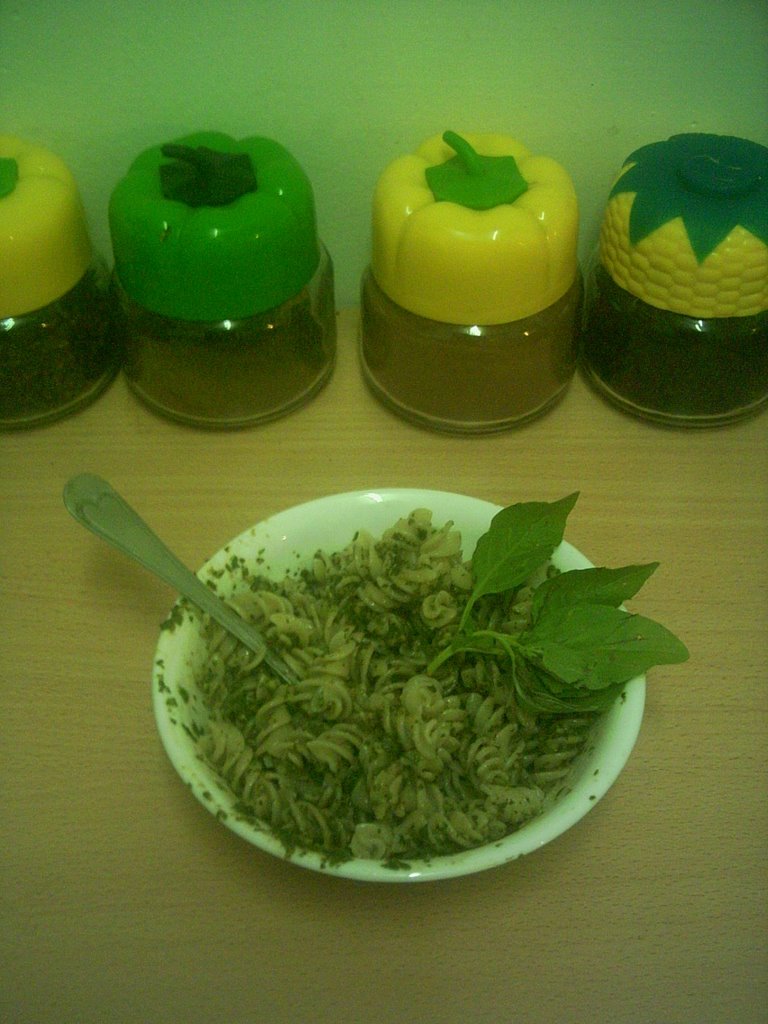
Fortunately, our food processor was up to the task, and we were able to produce two dangerously unbalanced bowls of Tinkyada brown rice pasta with fresh, simple, homemade pesto. I know, not a remarkable feat. And yet, here it is. I wish I could comment on how well this keeps in the fridge, but as I said, we were hungry, and the entire batch was immediately consumed.

Homemade Pesto Sauce

2 cups fresh basil leaves
1/2 cup excellent quality olive oil
3 tablespoons pine nuts
3 large garlic cloves
1 tablespoon salt

Mix in food processor (adding small batches of stuff at a time). Then, mix with pasta. Eat, enjoy, rest in simplicity.

Tuesday, July 11, 2006

A Tribute to Phyllis Glazer


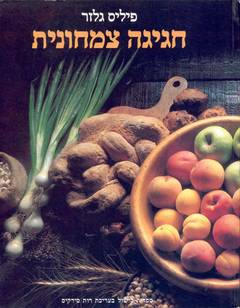
Hi, everyone; sorry for having disappeared for so long. I was out of the country, and just came back, still jetlagged and without much motivation for cooking beyond salads and omelettes. In such circumstances, the best I can do for us all is to use this opportunity to pay tribute to a wonderful lady - the "first lady" of vegetarian cooking in Israel: Phyllis Glazer.

Originally from Boston, Phyllis Glazer arrived in Israel and worked as an actress, gradually shifting to the world of vegetarianism. She started writing about healthy cuisine, whole grains and beans, and ecological issues, when none of these was anywhere near the Israeli mainstream. Recently, a festive 25th year anniversary edition of her book Vegetarian Feast was issued; she still writes extensively about vegetarian cooking and eating. Since writing this classic, she's written a second vegetarian book called Phyllis' Kitchen, which is also very good, and also a book about Jewish festival cooking.

I got acquainted with Glazer's work in my early twenties, as a student in Jerusalem. I learned to cook from two sources: my neighbor Frida and Glazer's book. I bought the book somewhere - can't remember well - and made each and every recipe in it, though I didn't follow it to the letter (I always like to invent and improve on written recipes). Glazer taught me the importance of combining whole grains and beans, the possibilities in vegetables I wasn't familiar with, and the secrets of quick breads, an American novelty I hadn't been exposed to. With her book, I made fruit custards, pureed soups, homemade granola, and bean casseroles. My first Irish soda bread came out of that book, as did my first muffins - real, genuine powerhouses of bran and fruit, not flavorless sweet treats. Much of my enthusiasm about healthy nutrition echoes the excitement conveyed by Glazer's writings, and her efforts to make vegetarianism more palatable to the Israeli mainstream.

If you read Hebrew, you'd do good to buy yourself a copy of the book. It's still relevant and useful. And if you don't, you can always wrap a banana in foil and freeze it (Glazer's simple and delicious ice-cream substitute) or make the following leftover dish - my take on one of her classics.

Brown Rice Patties

2 cups cooked brown rice
2 eggs
1/2-1 cup grated vegetables, like zuccini or carrots
1 onion, chopped
1 tablespoon cumin
1/3 cup whole wheat or brown rice flour

Mix all ingredients and make into flattened discs. Fry in olive oil, or, if desired - bake on a baking sheet until brown.

Tuesday, June 20, 2006

Buckwheat Salad

This is a quick but helpful entry, because this salad is oh-so-easy and good. I served it yesterday to my pal Rosie who stopped over for dinner.

Buckwheat is actually not a grain; it is a fruit seed, akin to rhubarb. But it is cooked and eaten like a grain. Buckwheat is rich in manganese and magnesium and contains plenty of insoluble fiber. A cup of cooked buckwheat has almost six grams of protein.

I made this salad with cooked buckwheat, but if you have uncooked stuff, just cook it and add the vegetables in the very last minute of cooking.


Buckwheat Salad

2 cups cooked buckwheat
1/2 onion
3 garlic cloves
4 carrots, grated
2 zuccini or summer squashes, grated (the food processor is truly a great invention)
2-3 tbsp water or vegetable broth

Heat some oil in a wok. Add onions and garlic and sautee for a while. Add the grated carrots and zuccinis, and sautee for about five minutes, adding broth if stuff sticks to the wok too much. Then, add buckwheat and mix well together in the wok, adding more broth if necessary. Enjoy.

Saturday, June 17, 2006

Missing Meat?


My recent post about TVP yielded several emails and conversations about the place of meat substitutes in a vegetarian diet. The comments that most piqued my curiosity were tose of my old-timer vegetarian pals, who questioned the need to eat anything "resembling meat" at all, merely for the sake of how it looks.

They do have a point, there. We all understand the importance of eating enough protein, iron and B12; every responsible vegetarian (well, every responsible person, for that matter) has to take precautions against deficiencies and consume enough protein-rich grains, beans and seeds. As long as this is quality protein, it's not important what it looks like. Or, as my grandma says sometimes, "it doesn't stay pretty in your stomach".

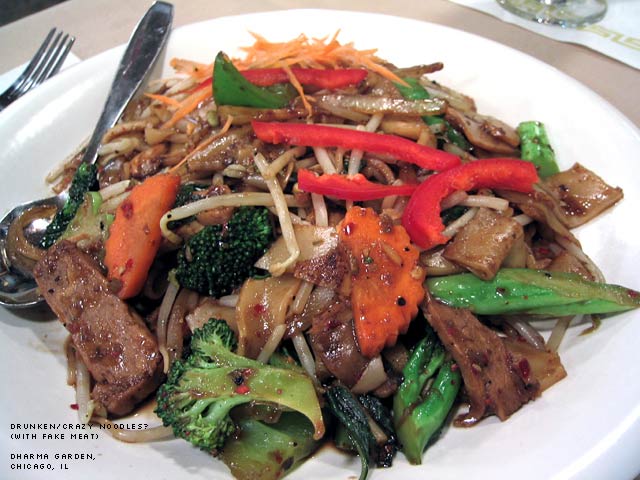
It is, therefore, quite entertaining to see how food industries insist on producing highly-processed, meticulously-designed products which are supposed to be meat substitutes. Tofurkey can be quite funny; it's made to look like a real turkey. Lightlife produces a series of soy-made salamis and bolognes and turkey slices that look very much like the original (and, if memory serves me right, taste quite like it, too). A short google of "fake meat" or "mock meat" will take you to quite a bunch of links, including restaurant links, which sport realistic-looking "meat" recipes for vegetarians, such as this picture.


This stuff was most likely made from TVP or from seitan, which is textured wheat gluten. Both of these products happen to contain a good amount of good quality protein, but that's not why they're there - they're there to remind vegetarians of meat. The absurd thing is that not all these substitutes have protein, or even are good for you. For example, Tivall, a wildly successful Israeli food manufacturer, produces "wiener schnitzels" made of corn and broccoli. Yes, it has hydrolized vegetable protein (?!?!) and bread crumbs and "flavoring", but how much actual good protein is in there? Is it just that we need a patty of something on one corner of our plate to feel as if we've eaten?

It's quite obvious - particularly from the Tofurkey example - that the vegetarian search for fake meat is cultural, not nutritional. We miss meat-based dishes of our omnivorous childhood, and want to recreate them in their cruelty-free form. An important corollary follows: it's not important whether the protein is actually in the fake meat, as long as we get the protein from somewhere. We can therefore have as much Tivall corn schnitzels as we like, we'll still need beans, and nuts, and perhaps cheese and eggs. This disconnect between how the food looks and what it actually is, is quite disturbing to anyone who wants to eat as close to nature as possible.

But, but but but, let's not dis our pals who eat these things too soon. For many people who come to vegetarianism, be it for health or conscience reasons, the move is very difficult. This is particularly true for societies in which meat is considered the centerpiece of the meal. Someone who was raised to think of meat as "the meal", and of rice, and beans, and vegetables, as "those things that come with the meal", it is very difficult to get used to meals that seem incomplete. Naturally, thinking beyond the traditional plate is to be encouraged; but there is nothing wrong with a little bit of nostalgia, particularly if you can indulge yourself in a healthy, fun way, and not feel deprived.

I don't miss meat. Really, I don't. I have no need to eat meat. Haven't had it for twelve years. There's one thing in particular I miss, though: my grandma's chopped liver. It was rich and creamy and nice, and full of fried onions. As I don't eat chicken innards anymore, I occasionally look for fun vegetarian pates and spreads, and yesterday I made my own in our kitchen. So, here it is, for your eating pleasure.


Vegetarian Chopped Liver

I don't know exactly what it is, in mock chopped liver recipes, that recreates the alchemy of actual liver. Is it the eggs and the nuts? Is it the aroma of the fried onions? Surely it can't be the zuccini, because I've looked everywhere for recipes, and found recipes that use mushrooms, green beans, and - an Israeli favorite - eggplants. Alas, I had a surplus of zuccini from Chubeza and absolutely had to use it up. I vaguely remembered having eaten something like this in Passover, but could not find the recipe, and my invented one turned out fine. The only problem was that I didn't add enough salt. We don't usually add salt, but this recipe is somewhat of an exception, so be generous with the salt shaker.

4-5 large zuccinis or summer squashes
2 large, white onions
1/3 cup good quality olive or canola oil
4 hard-boiled eggs
3/4 cup walnuts
salt and pepper

In a large pan or a wok, heat up the oil. Chop up the onions and fry them until brown. This requires patience: they absolutely must be dark brown for the flavor alchemy to work properly. Once they are nearly there, add up the chopped-up zuccinis. Keep frying, until the zuccini is golden and soft as well, and the onions emit their lovely fried aroma.

Meanwhile, back at the ranch, we need to take care of the eggs and nuts. Simply stick'em in your food processor bowl and grind them to dust.

Add the fried stuff to the food processor bowl, and keep grinding, until you get a brown, uniform paste. Keep tasting it ("oh, no, do we have to?") and add salt and pepper until your grandmother's presence is strongly felt in the kitchen. If you come from a different ethnic background and your grandma never makes chopped liver, you can channel mine - hers is fantastic. Anyway: remove from bowl and refrigerate. Enjoy with crackers, vegetables, and - for those of you who eat wheat - fresh bread.

Party Food : Part II

I was hoping to post about the farm day, when I got to see the organic farm and meet the vegetables, and their growers, face to face; it was a lovely morning. But the camera, with the farm pictures, has gone with Chad to Colorado, so we're left with stuffed zuccini.

Stuffed Zuccini

4 zuccini or summer squashes
1/2 white onion
5 mushrooms, or 10 mushroom stems (if you're stuffing the rest of the mushrooms)
1/2 cup crumbled goat feta cheese
3 garlic cloves

Cut each zuccini to about four pieces of equal size. With a small knife, remove some of the inside, leaving a little "cup" with a bottom.

Grate the stuff you took out of the zuccini; chop the mushrooms.

In a pan, sautee chopped garlic cloves and onion; then, add grated zuccini and chopped mushroom. Sautee all this together until soft and aromatic.

Then, mix in a bowl, with cheese. This is the stuffing.

Now, hear your oven to 180 degrees celsius. Scoop some stuffing into each of the zuccini "cups". Organize in a baking dish and bake for about 25-30 minutes, or until the zuccini is cooked but still firm. Enjoy!

Tuesday, June 13, 2006

Party Food (alas, no pictures): Part I

The other day I had lots of beautiful ladies of all shapes and sizes over here for a clothes swap, and had to serve them something to eat.

The original concept was of finger foods, but then things got complicated; some of the stuff I was planning to make required vegetables which were unavailable from our Chubeza delivery, and some of the ingredients simply called to make them into something else. Eventually I settled on a different, but fun, menu, and it got rave reviews from the ladies.

So here it is, for your cooking pleasure; part I includes recipes for cabbage rolls and stuffed mushrooms. Tune in tomorrow for stuffed zuccini.

Shavuot Cheese Suffles (see below)

Cabbage Rolls with Quinoa

This one, in its meat version, is an old Mennonite favorite, and Chad's family has been eating it for years. Chad and I have been working on a vegetarian version, and recently we discovered that a combination of quinoa and lentils for the filling works wonders. The following version, however, has only quinoa - but is equally delicious.

1 white cabbage
1 cup quinoa
1 onion
5-6 cloves of garlic
3 tbsp of rosemary, or herbs-de-provence, or any other mixed herb
2 1/2 cups vegetable broth
1-2 cups of your favorite homemade tomato sauce

In a pot, fry up the onion and garlic. Add the quinoa and herbs, and 2 cups vegetable broth. Bring to a boil, then lower the temperature, cover pot and cook for about 20 minutes. Drain any excess broth and set aside.

In another pot, place cabbage in water. Bring to a boil and cook for 10 minutes, or until cabbage becomes slightly translucent and leaves are soft. Drain and let cool.

Using a small, sharp knife, remove the core of the cabbage. Then, carefully peel each leaf at a time (this requires practice), and remove the white tough middle of each leaf (so the leaf remains complete, but can be easily bent).

Heat up your oven to 180 degrees celsius. Pick a nice, deep, wide baking dish and oil it lightly with olive oil. Pick up every cabbage leaf, and using a spoon, place a healthy spoonful of the quinoa mix in each leaf. Fold the sides and roll all the way. Place in baking dish. The idea is to put the leaves in the dish quite snugly. When the dish is full and you've run out of usable cabbage, mix the tomato sauce with the broth and pour on top of the cabbage. Put in oven and bake for 45 minutes.

Mash-rooms

25 champignon mushrooms
3 large potatoes
1/2 onion
olive oil
black pepper and chili flakes to taste

Carefully remove stems from all mushrooms. Chop up the stems and the onion, and fry in olive oil until brown and fragrant. Meanwhile, bake, boil or microwave the potatoes. Mash'em with the stems and onion. Then, stuff some of the mash into each stemless mushroom, place in a lightly-oiled baking dish, and put into a hot oven (200 degrees celsius would work) for about half an hour (or more, if you really want a crispy top).

Wednesday, June 07, 2006

Working Class Soy Products


The other day I stumbled upon a health food store I hadn't seen before; which is quite surprising, because it's right in the city center, on Dizengoff and Frischmann. The folks who work there are extremely nice and knowledgeable about the lovely stuff the city has to offer, including spices, teas, grains, baking and cooking products from cast iron and silicone, and various mystery items in bins.

It was one of these mystery items that I stumbled upon as I was looking for something nice to eat for dinner; it had strange, dry brown/beige pellets of varying sizes, and was very, very cheap. "What is this?" I asked. "You've never seen these before?" said the salesperson. "They are really, really cool; these are soy slices. You cook them like meat, only you have to soak them first".

Several hours later, I started searching the internet for interesting things to do with the funny pellets, which I now realized were called TVP (Textured Vegetable Protein). Apparenly, TVP has been around for a while, but has not enjoyed the yuppie publicity of tofu and soymilk. Probably because it is much, much cheaper. It's been served in workplace cafeterias and canteens way before vegetarianism became a lifestyle, rather than a financial necessity. And, yeah, it's very tasty.

As opposed to tofu and miso, TVP is not fermented. It is made from defatted, ground soy, and textured to look and feel - when wet - like a little sponge, with a texture not dissimilar from that of chewy Chinese beef or chicken bits (haven't had those for nearly fourteen years, but still got the memories). It is bought dry, then soaked in boiling water for several hours before it can be used. In fact, it's not dissimilar from seitan (wheat gluten puffs).

TVP seems to be a good alternative for folks transferring to vegetarianism after years of eating typical Western fare. For example, this website provides some ideas on how TVP can be "meat in disguise" in some common North American dishes. Here are some options, too.

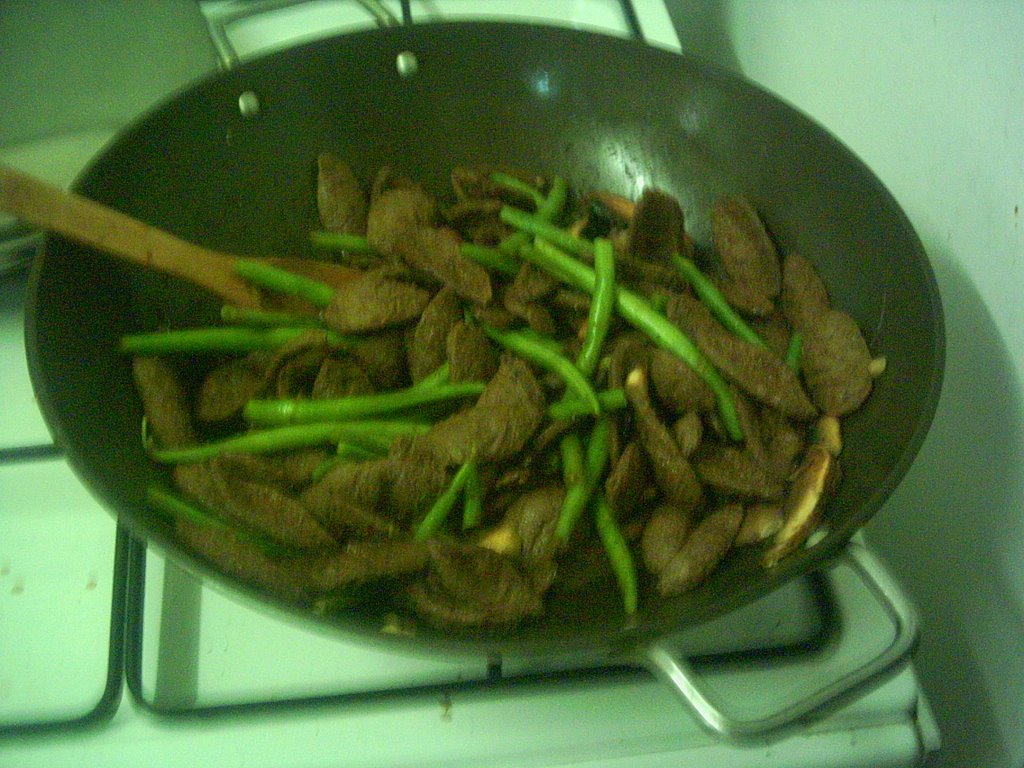
These recipes all indicate that TVP serves mostly as "fake meat". While I find no particular reason to constantly imitate meat in my kitchen, it's fun, occasionally, to eat something one used to eat as a meat eater and use TVP. I used it, therefore, to prepare a stir-fry "beef" with green beans and mushrooms (this week's delivery of green beans from the farm was particularly impressive). When Chad came home, he came up with the idea of eating the leftovers in pita, with tchina, as one would in a shewarma stand (see other picture). It was very good both ways.


Stir-Fry TVP "Beef" with Green Beans and Mushrooms

30 pellets of dark TVP
1 cup fresh green beans
1 cup fresh forest mushrooms, or soaked shiitake mushrooms
4 garlic cloves
1/2 cup good quality soy sauce
1/2 inch fresh ginger
1 tsp chili flakes, or hot sauce
(optional) 1/2 tsp honey

STEP I: prepare the TVP. Soak it in lots and lots of boiling water for a good eight hours (leave it soaking when you go to work, it'll be ready for dinner). It will nearly quadruple its size. Then, discard the water, and gently squeeze the puffed sponges to remove a bit more water (this will leave room for them to soak the sauce).

STEP II: Cut off (scissors are really fun for this) the green bean tips. Slice the mushrooms and garlic cloves. We start off with some oil in the wok, then add the garlic, ginger and chili/hot sauce a nice aroma fills the room. Then, we put the TVP in the wok and just let it absorb and get used to its new situation. Not much stirring (yeah, you, leave it be!). After the TVP begins to warm up and get slightly darker (five minutes is enough), add up the soy sauce, honey (if desired) and any more aromatics, if you so prefer. Then add the vegetables, and stir fry for another five minutes. Voila, "beef".

My serving suggestion: eat as is, or on brown rice.
Chad's serving suggestion: stuff into a pita with tchina and raw vegetables.

So, there's another way to eat some vegetable protein and not go broke. Enjoy!

Tuesday, June 06, 2006

The Entire City is Going on a Diet


When I have thoughts of leaving my tiny metropolis and leaving somewhere else, this is exactly the sort of thing that always dissuades me from doing so. Tel Aviv is one of the most entertaining and amusing cities in the world. Every day there are fascinating things going on. Right now, there's a coffee and theater event close to my house, and several fantastic exhibitions at the Tel Aviv Museum of Art.

However, the most entertaining occurrence these days is Health and the City - a citywide event, happening mostly on the beaches, and designed to make all of us fitter and healthier. The idea is as follows: there are fitness classes, at almost all hours, right on the beach; health consultants, dieticians, and exercise instructors give free advice to all participants; many restaurants in the city are offering discount salads and whole-grain dishes; there are lots of discounts in fitness clubs; the mayor even spoke on the radio, encouraging all citizens to walk more.

I know some of the lesser enthusiasts would see this as a nuisance and perhaps even a paternalistic attempt to regulate the citypeople's behavior (after all, are we less worthy citizens if we don't exercise, or if we eat junk?). I also dislike the emphasis on weight loss, rather than health (this city needs less, not more, weight-related neurosis). However, you really have to applaud the city for creating what I believe must be the world's greatest health support group. Going on my daily walk, I saw folks doing pilates on the beach and push ups in the park; it was fun to see how dedicated everyone was, and I can only hope it will lead folks to explore local farming and nutrition, as well.

Most important, these enterprises always make me smile; it's so much fun to live in such a benevolently crazy place.

Saturday, June 03, 2006

Goats and Cabbage in the Desert


What you see in the somewhat dark picture, is a post-Shavuot dinnertime snack: tomatoes with basil, various types of goat cheese from the desert, and a really cool cabbage salad.

We spent our Shavuot vacation camping in the Negev, Israel's southern desert area, and were very surprised and heartened to meet knowledgeable and idealistic people who use ecology and organic farming to make the desert a wonderful area for activism. Shavuot is a holiday of harvest and bounty, and a good opportunity to support small farms. In the last few years, several of these small farms have opened in the vicinity of Mitzpe Ramon, a town right next to the breathtaking Ramon Anticline, an amazing place to see Mother Nature at work. I suppose it is this beauty and magnitute of natural forces that inspired good people to come along and start small farms, growing all sorts of interesting vegetables which benefit from the desert climate, as well as raising goats and making excellent goat cheese.

We got to visit Naot Farm, where we talked to the farmworkers about the realities of raising goats in the desert and of making sheep. Apparently, the desert climate is rough, but not impossible, to work with, and the goats enjoy fresh pasture and desert plants. Eating the cheese, one can almost taste the different plants the goats have eaten.

Here's a simple baking recipe I intend to use with the lovely cheeses we bought; it can be easily done with a twelve-hole muffin pan.

Shavuot Cheese Suffles

3 cups whole wheat or whole rice flour
1 1/2 cup milk, buttermilk or goat yogurt
3 eggs, beaten
1 tbsp olive oil (plus oil or spray for oiling the pan)
a rosemary twig
12 cubes of good quality goat cheese

Heat oven to around 200 degrees celsius. Sift flour into large bowl; slowly add milk and eggs and mix until uniform. Add oil and chop in rosemary. Carefully pour mix into muffin holes, filling them up to about 3/4 of their height; then, drop a cube of cheese into the center of every hole. Bake for 45 minutes, or until mixture has finished rising and is golden and fluffy. Delicious for breakfast.

Elsewhere, we were served a simple and nice cabbage salad, involving chopped cabbage, vinegar, oil, and lots of fresh dill. Which we then reconstructed at home with our Chubeza cabbage. By the way, we happened to read, in one of the places we visited, that the common association of cabbage with gas stems not so much from the cabbage itself, but from its interaction with common pesticides; organic cabbages are generally thought to be gas-free.

Tuesday, May 30, 2006

Yesterday's Dinner, Today's Fabulous Lunch

The nice black-bean-sauce dish we served Ilan over the weekend served us well this morning. We had cooked something like three pounds of azuki black beans, and froze them for future use.

That future was this morning, when I took five minutes to prepare us a great lunch, that can be eaten cold and is extremely tasty. The dish is inspired by (but quite different from) the neat salads in Benny Seida's cool salad book.

Black Azuki Beans with Goat Cheese, Tomatoes and Basil
2 cups cooked black azuki beans
10 cherry tomatoes, halved
100 grams goat cheese, crumbled
10 basil leaves
5 sun-dried tomatoes, soaked in hot water for a minute or two and chopped
1 tsp pesto sauce

Mix all ingredients and enjoy.

Monday, May 29, 2006

They come in all colors!


As we got home yesterday, our Chubeza box was waiting for us in the parking lot. We couldn't wait to get into the house and see what was in it. And, indeed, among many other surprises, there was fresh spinach, and there were summer squashes in three colors!

Summer squash, and its different varieties (like zuccini, crookneck and straitneck squash, and pattypan squash) originates from South America, and despite its presence in year-round supermarkets, is really a summer vegetable. The winter ones are really much inferior to the creamy, rich summer ones, which, while eaten, make you feel as if the sun is warming up your belly from inside. Summer squash is kind of like a "decathlon nutrition source"; it doesn't excel in any nutrient category, but it provides many of them.

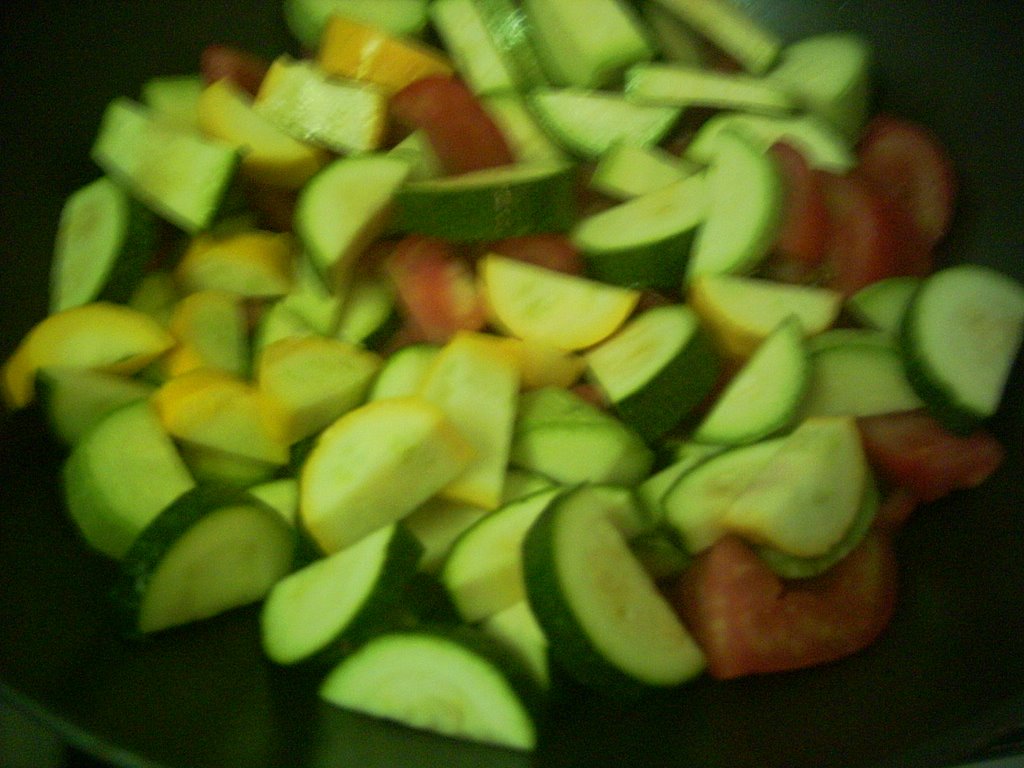
My grandmother used to make a dish called Givetch, which featured zuccini. Each family has its own version of givetch, which is a mixed vegetable dish; ours featured mostly zuccini and tomato. Yesterday, we had our own version, which contained the fresh spinach, as well as basil, and three colors of squash. Actually, it's sort of a renegade version - because, while in regular givetch, you cook everything for very long until it becomes soft, here you cook everything just barely, so you still feel yourself biting into the vegetables. What you see in the above picture is the beginning of the cooking process - aren't those colors fun?

Neo-Givetch with Summer Squash

3 large squashes, preferrably of different colors
2 large, ripe tomatoes
3 garlic cloves
1 tbsp olive oil
1 cup fresh spinach leaves
20 basil leaves
dash of frsh ground chili pepper

Cut each squash to half, then slice to semicircles. Cube the tomatoes and chop the garlic cloves. Heat up oil in a deep pan or wok, add the garlic. Then, we go by order of hardness: in go the squashes; then, the tomatoes; and finally, the spinach leaves and half the basil. Each vegetable gets added about two minutes after the previous one's been added. We cook everything a little longer, until the spinach leaves wilt, the tomatoes become the sauce, and the squash is pleasant to eat. Eat happily on top of your favorite grain.

Fabulous Greens!


Over the weekend, we had an unexpected but very welcome guest for dinner: my dear old friend Ilan. Fortunately, he came on a day when Chad was energetic enough to cook a very special dish: kale, mushrooms and tofu in black bean sauce.

The little black beans were somewhat of a mystery: I had picked them up in the Asian market, and only days afterwards did I find out they were simply a black variety of azuki beans, which are extremely beneficial for the metabolism. We cooked two pounds of them in broth, freezing most of them to eat over the week, but left out something like three or four cups; the sauce is simply mashed black beans with soy, garlic and some chili pepper. Chad was the architect of this one, but I think I can reconstruct how he did it.

Kale, Mushrooms and Tofu in Black Bean Sauce


1 small package of extra-firm tofu
10 large forest mushrooms
10-15 leaves of kale (our variety had pretty, purple veins)
1/2 a head of a purple cabbage
5 sliced garlic cloves
4 cups of cooked black azuki beans
1/2 cup soy sauce
1 tsp ground chili

Tear up kale leaves, slice mushrooms thickly, slice cabbage into ribbons, and cut tofu into cubes.

In a small saucer, heat up some oil (canola or olive). When hot, add about half of the garlic, then follow with soy sauce. Take about 1/2 cup of the black beans, add them to the saucer, and mash them with the back of a wooden spoon, while mixing them up with the other ingredients. They should puree quite easily, rendering an exquisite, black sauce.

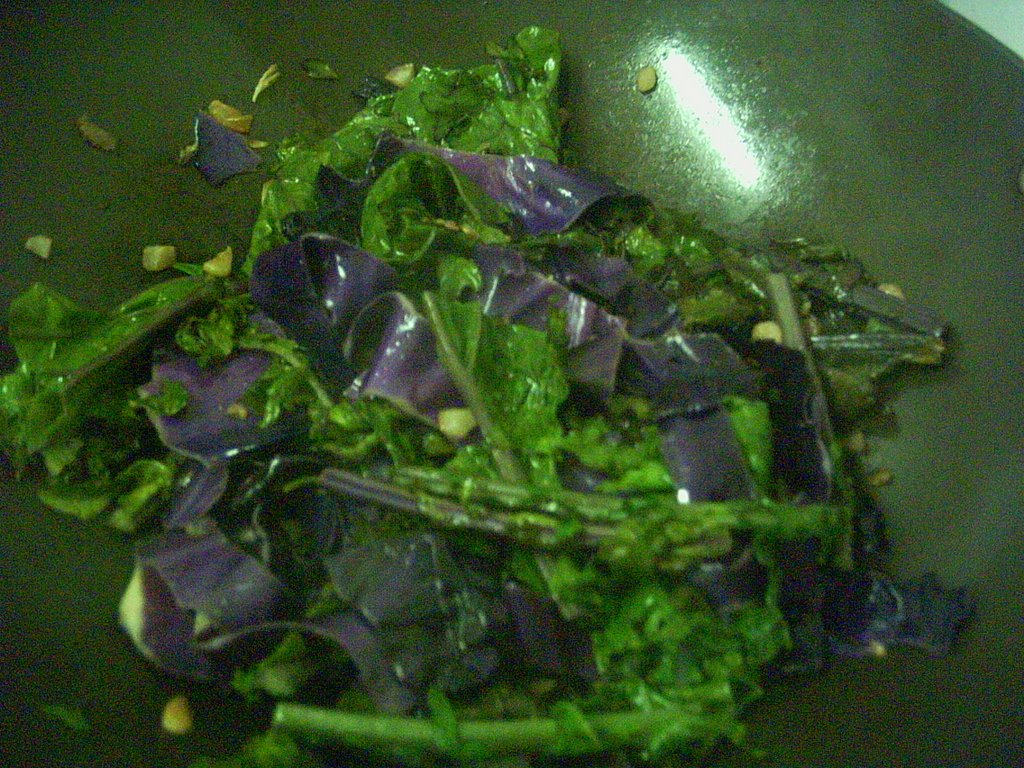
Now, pick up your wok; heat up some oil and add the rest of the garlic. Place tofu cubes in bottom of wok and let brown for a while. Then, add mushrooms, and after a couple of minutes, add the kale, the cabbage ribbons, and a tablespoon of water or vegetable broth. When the kale wilts and is good to eat, pour black bean sauce over the vegetables and gently mix to coat them. When everything is thoroughly coated, serve over the remainder of the black beans, or over rice.

Saturday, May 27, 2006

Appetite, Nutrition, Feminism


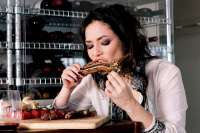
The picture you see in this post comes from the new fashion catalog of an Israeli designer store for women, Comme Il Faut. Comme Il Faut is a fashion store which adopts an interesting and controversial concept: selling expensive, well-tailored, chic clothing - but with a feminist edge. Their catalogues often feature a variety of Israeli women of all sizes, professions, ages and shapes; the glossy pages feature a variety of women in their seventies, lesbian couples, crossdressing men, large women, etc, who are mentioned by name, age and profession. On the store's shelves, in addition to shirts, dresses and pants, you'll find basic feminist literature (Simone de Beauvoir, bell hooks, Naomi Wolf) and newer books on women, violence, activism, body image, etc. The store and its image has been the focus of an animated feminist debate. Despite their commitment to fair trade, the Israeli-Palestinian peace process, equal pay and fair treatment for women, the store caters to upper-class women, the only ones who can afford their high-priced clothing, and is therefore somewhat of an exclusive space, which makes their radical feminist messages somewhat problematic.

This is, however, a blog about food and nutrition, which is why I want to discuss the store's latest campaign, titled "Bon Appetit, Honey". The catalog and motto of the summer season is to encourage women to eat heartily, to indulge themselves in food, to avoid depriving themselves of anything, and to reflect on body image and on food choices they make as a feminist issues. As you can see above, the summer catalogue sports beautiful women of all ilks heartily and happily biting into meat, pasta, cake, ice cream, etc, etc.

The store's focus on food is not surprising. Next to their flag store at the Tel Aviv Harbor, in a special and pampering compound, they have a fabulous cafe, serving great meals made with wholesome, organic ingredients, blended fruit and vegetable juices, and excellent homey desserts. The connection between womanhood, body, fashion and food is therefore a very immediate one. To make things more obvious, the current campaign is accompanied by a brochure explaining how the confinement of women to dietetic, barely-survival food has been a technique for debilitating and weakening women, and for establishing their place in society as people who primarily nourish others while depriving themselves of the joys of food.

Now, I have a lot of sympathy for messages aimed at liberating women from confining social institutions, and, in particular, the institution of fad dieting and pleasure avoidance. So, notwithstanding my criticism of the campaign which will follow, I am happy to see these messages infiltrate our consciousness and take up space which, otherwise, would have been taken up by anorexic 15-year-olds. The store's guest book features an entry from a young woman with anorexia, who tells them that she hung the catalogue in the wing where she, and other anorexic girls, are hospitalized, and they get a lot of encouragement out of it. Can't say this, in itself, is a negative trend. Not only that, but some of my clothes, I confess, were purchased in Comme Il Faut, and these ladies are truly talented, so I can't really begrudge them too much. However. (of course there's a "however"; you should know me already).

Comme Il Faut is a fashion house. A fashion house, albeit an idealist, activist one, is all about selling clothes. Clothes are designed to make women look their best, and this "best" can't be entirely disconnected from social notions of what looks well and what doesn't. Moreover, Comme Il Faut is a fashion house that, shall we put it bluntly? sells clothes to upper- and middle-class women. Affluent women. Women who have enough social cache, resources and leisure to be concerned in many ways about their looks and grooming. It is very probable that many of the customers are those who engage in several delightful activities, like the botox injections we discussed earlier. It is naive to expect that this population will be genuinely moved, by the store's message, and order a large dish of ice-cream at the cafe. After all, wouldn't they want to look their best in their newly purchased gorgeous clothes? Yes, it's important that Comme Il Faut is talking the talk. But let's not be illusioned into thinking that their customers are likely to walk the walk.

What we have here, ladies, is excellent, politically-correct (and I say this in the most positive, irony-free sense of the word), healthy, empowering ideology, at the service of our old pal, capitalism. Indeed, by shopping at Comme Il Faut we are more likely to contribute to fair salaries of female workers who are treated like family, and to donations to various peace organizations. But primarily, we are contributing to the wealth of an extremely successful enterprise for profit. Let's not forget that (the same can be said about shopping at feel-good, organic, cruelty-free beauty shops: here's what my thoughtful new pal (hopefully), Carmit, has to say, in Hebrew, about the Body Shop). The empowering messages make this contribution more palatable, but they don't cancel out its existence. The more extreme radicals might say that, by having these messages supposedly broadcasted by the hegemony, we are numbing women from engaging in ideological battles (why go out to the streets in protest when we can purchase another gorgeous pair of pants and feel good about it?) - but I'm not sure the situation is made so much worse by this campaign. It just isn't made as better as we'd hope for.

And here's where I come to the actual issue - the food. The catalogue is encouraging women not to leave the steak, cake and ice cream to the men, and to engage in the world of sensual culinary pleasure. Yay! Yay? I'm not so sure. I'm not sure that feminism is well served by encouraging women to consume red meat, white bread, sugars and sweets. Indeed, dammit, it's annoying that food is such a gendered field. It's annoying that social conventions are regulating different food consumption regimes for women and men. The answer is not to clog our collective arteries in a gender blind fashion. Folks, if we want to conquer the world, what's going to help us do it? What is going to make us stronger and healthier so we have energy for social reform? A sugar crash from a chocolate cake, or a nice bowl of brown rice and beans with steamed vegetables? Depriving outselves of calories is never a good idea; but depriving ourselves of nutrients which make us competent and help our bodies help us isn't any better.

My argument here isn't abstract. The personal is political. So here it goes. My health comes from months of making a conscious effort to eat extremely healthy food. Yes, I've lost weight, but I also feel a lot better, phsicaly. Making the effort to eat wholesome and organic was one of the best things I ever did for myself and I refuse to be told that it was a weakening, unfeminist thing to do. How, exactly, would a message encouraging the consumption of ice cream be helpful or empowering for my life? And why does health need to be equated with deprivation? Isn't this message, in itself, unfeminist, by buying into the existing capitalist foodchain which makes sustainable, organic farming, so removed from the reality of working-class family nutrition? Is it only possible to enjoy life by consuming red meat? Is clogging our arteries the best method we can think about for subverting patriarchy?

Naaaaaah.

If we want real feminist power, of course we must oppose any message that we should starve outselves to fit anyone's image of beauty. But we must equally oppose any half-baked message that tells us to give up our health and livelihood in the name of feminism. You hungry, girl? Spend the time to make yourself a nice bowl of grains and greens. Grab a nice plate of hummus, and wipe it off the plate with whole-grain pita. Eat a hearty vegetable stew, then lick the plate. Enjoy a refreshing drink of cultured yogurt. Support whoever works hard to grow and supply you with the ingredients for healthy, satisfying meals. Go for a nice walk, fill your lungs with fresh air, and think how lucky you are to live where healthy fresh food is readily available for you. The first step for causing postive change in the world is taking good care of ourselves, so that we have the most important resource - our health - at our hands when we do so. The next stage, is to make this health, through local, sustainable food, available to all. Now that's real power, and surely if we've done that, or at least done our share for ourselves and for others, we all (regardless of our income) deserve a nice, comfortable, well-tailored pair of pants.
Thursday, May 25, 2006

Papaya vs. Botox


The other day I was saddened to read an article on Bananot, an Israeli girl magazine, about botox injections. The author tells of her experience going to get the injection, her sadness at her lost youth, and finally - despite all the shortcomings of the process - the coveted award: a stranger in the street guessed her age to be five years less than she actually is.

I don't know where to begin my arguments against this article; one has to applaud the author's bravery at coming out and saying she got the injection. However, I see the fact that people are feeling comfortable to openly admit they get them as an indicator that these procedures have become more acceptable than before, and it's quite possible that many women I see in Tel Aviv have gone through this. Which is why I'll add my non-relenting, sanctimonious voice to the choir, and say things most of you have already heard, or said yourselves, in numerous occasions.

My main argument against botox is quite obvious, and simply involves the nature of the procedure: you're basically injecting yourself with poison. You're consciously and deliberatly introducing a dangerous, muscle-paralyzing poison into your very own precious body, for the purpose of, well, being something that some would define "pretty". Have I already mentioned that botox is poison? The author seems to understand this, and nevertheless, the immediate effects on health somehow fail to register. She playfully tells us how one of her eyebrows "fell down" and was lower than the other, but this menacing occurrence does not trigger any deeper understanding about cause and effect. The fact that one might get sick if one drinks, say, ink, is easily acknowledged; why would introducing harmful substances through other means make you any better?

For some reason, this procedure scares me more than that old-timer pal, the facelift. Hideous as going under surgery to tuck in some face may seem, at least it's expensive, and surgical, and you expect folks to give it careful thought before doing it (though the numbers of women getting plastic surgery, including facelifts, are getting alarmingly big). The botox craze is worse in the sense that it's less expensive and the process itself is less lengthy. Of course, it is not cheap at all, and involves some readjustment of the face and some recovery, but all in all, the unbearable lightness of poisoning yourself makes everything seem so much more demonic somehow.

And why is that? the Weberian, Protestant-Ethos part of me is upset about the attitude that "easy fixes" are readily available for any inconvenience we encounter. Rather than thoroughly treating our wounds (or realizing they are not wounds at all) we stick cosmetic band-aids on them. Learning to be proud of our faces, which reflect the faces of your mothers, and grandmothers, and ancestors, is too much work. Yes, so much better for all involved if we just inject something. Observing how the corners of our eyes are lined from years of laughing with dear friends, and how our forehead is lined from years of thinking, and concentrating, and worrying about our loved ones, is too much work. Much better for us to erase our past and experiences. The idea that technology will be right next to us, lending us a helping hand whenever life becomes a tad more complicated, propels us to stop our inner search, to stick with the easy solution, to take the proverbial blue pill.

And what is this valuable asset that we wish to recreate by injecting poison into our face? Yes, of course, it's youth - that wonderful, carefree time, when we were completely helpless in any way that could shape our future. That time when we were cruel to each other, incommunicado with our parents, busy conducting world wars across the social food chain in school, and devoid of any resources for taking control of our lives. Is that the period we wish to relieve? Is this equation of women with teenagers meant at making them as helpless and lost as teenagers? Ladies, do think of your life in your thirties, forties, fifties, sixties; yes, it's more complex. You have jobs, and families, and dilemmas, and bills, and bureaucracy. But you can take matters into your own hands, and use your wisdom and experience (whose traces are on your wise, beautiful face) to solve your problems. With erasing the signs of your wisdom and experience comes a symbolic, and perhaps more than symbolic, negation of these very experiences and their value to your life. You once again relinquish control and place yourself in the hands of a dangerous chemical, which takes away your control over something which is extremely close to your personality: your facial expressions. You relinquish control of your face muscles, echoing the time when our faces were wrinkle-free and our control over our circumstances, relationships and future was nil.

The ultimate "award" for this dangerous and futile exercise in self-weakening is given in the form of a compliment from a stranger. If we are incomplete and unhappy until some man we don't know tells us we look thirty-five and not a day older, what does it say about us? What does that say about our relationship with ourselves and with the loved people who have walked all these erased years beside us? What does that tell us about the source and strength of our self esteem? Self esteem, self empowerment, pride in the self, does not come in a plastic container; "for if that which you seek, you find not within yourself, you will never find it without".

What to do, then? The most important thing is to take pride in who you are, in your age, in your experiences. Easier said than done in an era of aggressive advertisements, but important. No one, apparently, will facilitate this for us - we must do it ourselves. When people ask you how old you are, for heavens' sake, tell them your right age. When you look at your lines in the mirror, acknowledge the joys and sorrows that shaped them, like small symbolic tattoos marking the stations of change and shift in your life.

This does not mean letting your body weaken. If we want to live and love on this planet, we must do whatever we can to be healthy and strong. The work needs to be done; the children need to be raised; the ideals need to be fought. To do that, you'll need a robust musclo-skeletal system, a strong digestive system, clean and healthy lungs. Eat whole, organic, fresh natural foods. Cook for yourself and your family. Take a walk, or a swim, or a class on a regular basis. Forge a strong relationship of cooperation between your mind and your body.

And finally, want to be pretty? Your food can give you a hand with that. There is a variety of great resources out there on natural, harmless substances that can heal and enrich your skin. Two of the better books I use are Rosemary Gladstar's Herbal Healing for Women and Dina Falconi's Earthly Bodies and Heavenly Hair. This doesn't have to be a cumbersome regime; you can use some of the vegetables and fruit you cook with to get the benefits.

Two good examples are papaya and lemons, both good for a combination/oily skin complection. Making tchina, vegetable salad, or anything that needs lemon juice? Take a piece of the lemon and slather its pulp over your face. Rinse out in ten minutes. Papaya, which includes the wonderful enzyme Papain, is even better, but be sure to rinse it off in five minutes, as the active ingredients are quite strong. If your skin is sensitive, there's a variety of organic, hypo-allergenic products out there, and many of them do not experiment on animals (for a great list of cruelty-free products in Israel, see here). The lemon and papaya treatments are tried and true methods for mattifying the skin, cleaning the pores and absorbing excess oils. Naturally (no pun intended), they do not wipe off your laughter or worry lines. Assuming that as a live, vibrant woman, you occasionally worry, and sometimes laugh, we'll just have to accept you, and your beauty, and your experience - the way you are.

Wednesday, May 24, 2006

Food Festival Addendum

Yesterday, while talking to a student about the food festival, I finally managed to realize and verbalize what was so bizarre for me in the whole experience. There was stark contrast between the survivalist, let's-eat-'cause-tomorrow-there-ain't-gonna-be-any-food attitude of the folks and the luxurious, toy-like dishes served. It was, at the same time, a feeling of apocalypse and decadence which made the festival into a military operation of fast gorging of delicacies, rather than the sort-of-Roman-feast it was supposed to be.

Tel Aviv Food Festival

Hiya, all; not much cooking this week, yet, except for some organic mashed potatoes. The reasons for this absence from the kitchen are quite complex, but they certainly include our visit to the Tel Aviv food festival, Taste of the City.

The idea is quite fun: many of the city's wonderful restaurants open large booths, where they sell small portions of the best dishes in their menus for a relatively inexpensive price. For example, a set of four Dim Sum dumplings is sold for 20 NIS. The booths are located around Hayarkon park, and the very many visitors (more than three hundred thousand last year!) walk between them, making a meal out of various interesting entrees.

For the most part, folks behave in a civil manner and don't push each other on the way to the food, which is also facilitated by the large number of service people on each booth. It is, however, a strange feeling to be part of a large picnic where everyone, including you, is stuffing their faces and standing in line for more. I can see how this pastime can really turn off those of us with more delicate tastes. It also raises the question of garbage, as this festival is based on a huge amount of plastic and paper plates, and there is no recycling structure in sight.

As far as vegetarian options go, things looked quite good. Almost each restaurant had some sort of a vegetarian option. Sushi places offered vegetarian sushi and agedashi tofu; various rice and noodle dishes, with vegetables, as well as veg and tofu stir-frys, were offered at the Thai and Chinese places; pasta places had vegetarian pastas; and there was plenty of fresh squeezed juices and smoothies for those who preferred to pass on the many beer varieties. The best part was a small and modest booth, bearing the sign "sun soya" or "soya sun", which offered "meat" based on tofu and wheat gluten, with vegetables, silver noodles and brown rice. I think we're going to experiment more with fake meats at home. And, of course, the nice neighboring booth sold little boxes of raspberries, so we had our breakfast for the following morning in hand. All in all, quite an entertaining way to pass the evening. The one thing that spoiled some of the fun was the commercial megacorp booths, with noisy music, dancers, and incessant flier-handing. As we were heading off (by foot - you would not believe the traffic!), a lady handed us some sugar-free gum samples, to finish off the experience.

When we got home, we found our vegetable box awaiting us, with tomatoes, cucumbers, lettuce, potatoes, carrots, beets, zuccini (in four different colors!), kale, parsley, cabbage and red peppers. It's vegetable salad day, today, for both of us; but we promise to be more creative over the weekend.

Saturday, May 20, 2006

Shakshuka


My vegan friends will have to excuse me for this one entry, in which we shall discuss a delicious and nutritious member of the animal protein: eggs. Eggs contain concentrated, high quality protein, and despite being maligned for cholesterol content, in fact, contain beneficial cholesterol which is essential for our bodies. Good eggs are also an excellent source of omega-3 acids. Naturally, there are various substitutes for eggs, and our recipe for today can be made with any of them, but this is a good opportunity to reflect on the egg industry.

Industrial production of eggs takes place in chicken coops, which are horrible, inhumane places. The chickens are placed in tiny cages, one against the other, with no room to move; many of them get sick standing there, and as a consequence are fed dreadful antibiotics. They are also force-fed things that are extremely harmful for them; given this situation, I'm not too excited about eating eggs that come from this industry.

There are other options, which, while not perfect, are substantially better. Free range eggs allow the hens to walk freely in the yard and eat organic, plant-based food. However, as in the regular egg industry, hens are often debeaked, and male chicken killed and discarded at birth.

Choosing to eat eggs is a very personal decision. For those who have eggs once in a while, choosing organic and free range diminishes the problems with the industry, though it doesn't make them go away. Either way, you can have the following recipe with eggs or tofu, to suit your choices.

The recipe is for yet another Israeli staple, this time, originally, from Libya: Shakshuka. Shakshuka is an egg dish where the eggs are cooked in a hot skillet filled with spicy tomato-pepper sauce. It works really well as a breakfast; those of you who feel well combining starches and protein are welcome to wipe off the remaining sauce with some good bread.


Shakshouka (serves four)

3 red peppers
2 tomatoes
1 large onion
6 cloves garlic
1 can organic tomato paste
water or vegetable broth
fresh ground chili
8 organic, free-range eggs, or a block of firm, crumbled tofu
fresh parsley

You'll need a large skillet with a flat bottom, which you'll glaze with olive oil and heat up. Then, you chop the onion and garlic in and add chili. When the kitchen starts smelling like there's something good happening, you chop and add the peppers and tomatoes; when they start getting soft, you add tomato paste, water or vegetable broth, and more chili. The liquids need to be added to the point when the mixture is quite diluted and watery. On a low fire, keep the sauce simmering until it reaches a viscuous quality - can take up to half an hour or more (why not do your laundry in the meantime? and while you're at it, clean the kitchen!). When the sauce is nice and viscuous, you add the eggs or tofu. If you're doing tofu, simply place the crumbs on top of the sauce. If you're doing eggs, gently break them up and place them over the tomato mixture - DO NOT MIX (it's prettier with the eggs whole). Then, cover the skillet and cook until the tofu absorbs the tomato sauce, or the eggs get hard to your heart's desire. Serve in the skillet, or carefully slide onto plates.

Now that we're out of tomatoes and peppers, we have only the sauerkraut, and a few cucumber survivors and some lettuce, to keep us until the good people of Chubeza bring us our new vegetables on Monday. But we shall be back with the new bounty!

Friday, May 19, 2006

The Beans Hummus is Made of: Chickpeas


Looking for something nice to eat yesterday, I looked at the zuccini drawer, disappointed to see that there were not as many left as I thought. It's funny to think that we were concerned whether we'd be able to finish off our Chubeza vegetable box every week. Then, my gaze fell on a jar of chickpeas, just standing there on the shelf and asking to be used. The word "hummus" came to mind, immediately, but then I started to think.

Hummus is a staple in Middle Eastern cuisine, and has many local and excellent variations. Several regions in the country are well known for the quality of their hummus; those "in the know" can argue the merits and shortcomings of hummus for hours. Some of the best places to eat hummus in Israel are the village of Abu Ghosh, which also holds beautiful music festivals (one of them coming up soon); the city of Jaffa, sporting Ali Karavan's legendary hummus eatery; and several places in the Gallillee, including the old city of Akko (Acre). One of Israel's online portals, Ynet, even polled its readers to find out where the best ten places for hummus were located. Yes, Israelis are obsessed with hummus; the city of Tel Aviv even holds an annual Hummus Festival, featuring the best places from all over the country. This year, the city has announced the festival will take place on the 23rd and 24th of August (and will receive live coverage from yours truly).

Which is why, attempting to make hummus at home is no easy feat, competing with all those culinary giants making it at their restaurants. I tried once; the result was grainy, and decent enough to be called "chickpea dip", but certainly not hummus. In fact, what I'd made reminded me of the stuff they sell in the US, which is nothing like really good hummus at all, and includes such yuppified transgressions as 'roasted pepper hummus', and garlic-overdosed varieties. Hebrew readers, read all about hummus abroad, and try to maintain your calm. All ye American folks eating what you think passes as hummus, you've been wronged, and I suggest you come visit the Middle East and taste what hummus should really be like. My friend Holi, who lives in Leeds, in his anguish and despair, learned to make magnificent Hummus, so I know it can be produced outside the Middle East; but until I can get him to divulge the secret, my hummus remains an incomplete feat. If your curiosity can't be appeased, and you can read Hebrew, here's a recipe that looks promising, paying appropriate attention to the alchemy of hummus, too.

So, for now, what I made with my hummus was a nice little chickpea think with tomatoes, onions, chilis, and Biriyani Masala. I shudder to call it "chana Masala", particularly following my recent complaints about the transgressions of hummus' cultural transplants; nevertheless, it was good and nourishing. Chickpeas contain a generous amount of both starch and protein, and when cooked right, are extremely tasty.

Chickpeas with Tomatoes and Onions

5 cups of cooked chickpeas (to cook'em: place chickpeas in a large bowl and cover with water; discard after an hour. Add new water and let soak overnight. Then, discard water again, place in pot, add fresh water to cover, and cook for about an hour or so, occasionally lifting the strange white foam that keeps rising to the surface. Drain and keep the cooking liquid).
3 fresh, ripe tomatoes
1 medium-sized onion
1 tbsp ground chili pepper
1/4 cup Biriyani Masala spice mix
1 generous tablespoon organic tomato paste

Cover bottom of large wok with olive oil. When oil is hot, add chopped onion, chili, and Biriyani Masala. Cook until onions are golden and kitchen is fragrant and happy. Then, add the tomatoes and drained chickpeas. Mix up and cook for a while; then, add tomato paste and some water from the chickpeas. Let simmer about twenty minutes, then eat with great joy.